
Author: Stan Switaj
On Tuesday, November 3, Americans vote in the 2026 midterm elections. Every seat in the House of Representatives is on the ballot, along with more than a third of the Senate and 36 governorships. The result decides who controls Congress for the second half of the president's term: who writes the budgets, who runs the committees, and how far the White House's agenda can go.
Here is what the research says, as of November 1, about how the House and Senate could change, which races decide it, and what each outcome would mean. This is an even-handed look at the evidence: where it favours Democrats, where it favours Republicans, and where it is simply too close to call.
Where Congress stands today
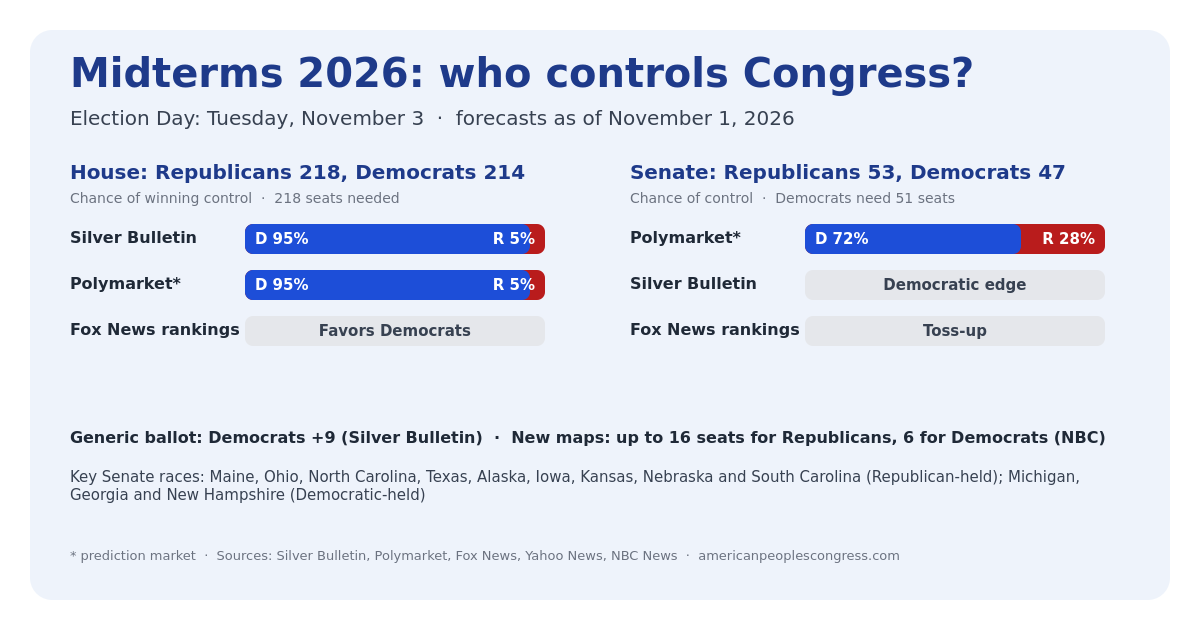
| Chamber | Republicans | Democrats | Other | Needed for control |
|---|---|---|---|---|
| House | 218 | 214 | 1 independent, 2 vacant | 218 of 435 |
| Senate | 53 | 47 | 51 for Democrats; 50 keeps Republicans in control, with Vice President JD Vance breaking ties |
Both majorities are narrow. In the House, Democrats need a net gain of only a few seats. In the Senate, they need to gain four seats on net while holding everything they have.
What the forecasts say
| Forecast | House | Senate |
|---|---|---|
| Silver Bulletin model | Democrats about 95% to win, netting about 25 seats on average | Democrats have "a meaningful edge" |
| Polymarket (prediction market) | Democrats 95% | Democrats 72% |
| Fox News Power Rankings | Point toward Democrats retaking the chamber | Toss-up |
The House picture is consistent across forecasters: Democrats are clear favourites. The Senate is where the real uncertainty lies, with estimates running from a toss-up to roughly seven-in-ten for Democrats.
Why the evidence favours Democrats
The national vote. Asked which party they want for Congress, voters favour Democrats by nearly 9 points on Silver Bulletin's average, and that lead has held steady for a month. History shows what margins like that have meant at this stage of a midterm year (RealClearPolitics averages):
| Year | Generic ballot at this point | What happened |
|---|---|---|
| 2010 | Republicans +6.5 | Republicans won the House |
| 2014 | Republicans +2.5 | Republicans held the House and won the Senate |
| 2018 | Democrats +7.2 | Democrats won the House |
| 2022 | Republicans +2.7 | Republicans won the House narrowly |
| 2026 | Democrats +9 | ? |
Presidential approval. President Trump's approval stands at 37.3% approve and 59.9% disapprove on Silver Bulletin's average. The New York Times reports it is the second-lowest approval for a president heading into a midterm since 1946, behind only Truman. On inflation and the cost of living, polls cited by Yahoo News show 70% disapproving. The president's party usually loses House seats in a midterm, and low approval tends to make those losses bigger.
Retirements. Sixty House members and two delegates are leaving: 36 Republicans and 26 Democrats. Open seats are generally easier to flip than seats with an incumbent running.
Why Republicans could still hold on
The maps. Unusually, ten states redrew their congressional maps in the middle of the decade. NBC News counted Republicans in position to gain as many as 16 seats from the new lines (in Texas, Florida, Ohio, Alabama, Louisiana, Tennessee, North Carolina and Missouri), against as many as 6 for Democrats (California and Utah). Virginia's Democratic redraw was blocked by its supreme court. That head start of up to ten seats is the biggest structural cushion Republicans have, and it is why forecasters expect a Democratic House gain, not a landslide.
The Senate map. Most Senate battlegrounds this year are in states President Trump carried: Texas, Ohio, Iowa, Kansas, Alaska, Nebraska and South Carolina. Democrats must win several of them to take control.
Polling misses. Polls have underestimated Republicans in some recent cycles. Senator Susan Collins of Maine, for example, trailed in most polls in 2020 and won comfortably. Many of this year's key Senate races are within a few points, well inside a normal polling error.
The Senate battleground
| State | Held by | Matchup | Latest polling |
|---|---|---|---|
| North Carolina | R (open) | Roy Cooper (D) vs. Michael Whatley (R) | Cooper ahead by about 11 on average |
| Ohio (special) | R | Sherrod Brown (D) vs. Sen. Jon Husted (R) | Brown ahead in nearly every poll since early October, by 2–6 points |
| Maine | R | Troy Jackson (D) vs. Sen. Susan Collins (R) | Jackson ahead by 2–7 points |
| Alaska | R | Mary Peltola (D) vs. Sen. Dan Sullivan (R) | Peltola ahead by 2–7 points |
| Texas | R (open) | James Talarico (D) vs. Ken Paxton (R) | Talarico ahead in most fall polls by 2–6; one poll has Paxton +1 |
| Kansas | R | Adam Hamilton (D) vs. Sen. Roger Marshall (R) | Hamilton ahead by 1–5 points in most polls |
| Iowa | R (open) | Josh Turek (D) vs. Ashley Hinson (R) | Small leads traded; essentially tied |
| Nebraska | R | Dan Osborn (independent) vs. Sen. Pete Ricketts (R) | Ricketts ahead by 1–6 points |
| South Carolina | R | Annie Andrews (D) vs. Darline Graham (R) | Graham about 2 ahead on average; NYT/Siena tied at 48% |
| Michigan | D (open) | Abdul El-Sayed (D) vs. Mike Rogers (R) | El-Sayed ahead in 11 of 12 October polls, by 1–7 points |
| Georgia | D | Sen. Jon Ossoff (D) vs. Mike Collins (R) | Ossoff ahead by about 9 on average |
| New Hampshire | D (open) | Chris Pappas (D) vs. John Sununu (R) | Pappas ahead by about 7 |
How the math works. If Democrats hold Michigan, Georgia and New Hampshire, they need four Republican seats. North Carolina and Ohio are the likeliest, which leaves two more to find among Maine, Alaska, Texas, Kansas and Iowa, all within a few points. (An independent win in Nebraska would not automatically count for Democrats.) Republicans keep control if they hold all but three of their seats, or flip a Democratic seat to offset losses. Several of these races are inside the margin of error, so the Senate could easily land anywhere from a narrow Republican majority to a small Democratic one.
The House battleground
The House will be decided in a few dozen competitive districts. One bellwether is Kentucky's 6th District, where President Trump won by 15 points in 2024 but which Fox News describes as close this cycle: if Democrats are competitive there, it points to a broad wave. Watch, too, the newly drawn districts in Texas, California, Ohio, North Carolina and Florida. Those maps were designed to change hands, and how close they come to their designers' intent will decide the size of any majority.
Beyond Congress
- Governors: 36 states elect governors. The current split is 26 Republican, 24 Democratic. Fox rates Alaska, Nevada and Georgia (Republican-held) and Wisconsin (open, Democratic-held) as toss-ups.
- Ballot measures: 145 statewide measures, including voter ID or noncitizen voting rules in 11 states, abortion measures in Missouri, Idaho, Virginia and Nevada, redistricting measures in Maryland, Missouri and Colorado, and a one-time wealth tax on billionaires in California.
Three ways it could turn out
1. Democrats win both chambers. Democrats would control which bills reach the floor, every committee, and the power to investigate the executive branch. A Democratic Senate would also decide which of the president's nominees, including judges, are confirmed. Expect divided government in its sharpest form: legislation blocked or vetoed, but heavy oversight.
2. Democrats win the House, Republicans keep the Senate. Split control like this last followed the 2018 midterms. The House gains oversight and the power of the purse, since spending bills start there. The Senate keeps confirming the president's nominees. Big legislation would need deals between the chambers, and the deadlines for government funding and the debt limit would become negotiating points.
3. Republicans keep both chambers. The forecasts give this the lowest chance. It would be an unusual result with presidential approval near 37%, and would let the administration's agenda continue through Congress with the current narrow margins.
Whichever way it goes, the new Congress inherits the same hard numbers. The national debt has passed $40 trillion and is still rising fast, inflation is running at 3.7%, and the Federal Reserve has signalled that its next move may be another rate rise. Control of Congress decides who gets to answer those questions, and how.
What to watch on election night
- 7:00 p.m. ET: polls close in Georgia, South Carolina, Virginia and most of Florida and New Hampshire. Early signs from Georgia (Ossoff) and New Hampshire (Pappas).
- 7:30 p.m. ET: North Carolina and Ohio close. Cooper and Brown are two of the four seats Democrats most need.
- 8:00 p.m. ET: Maine, Pennsylvania and most of Texas, Michigan and Kansas close. Maine and Texas may show where the Senate is heading.
- Late night and beyond: the West Coast closes at 11 p.m. ET and Alaska as late as 1 a.m. ET. Close races, and states that count mail ballots slowly, may take days. A narrow Senate could hang on Alaska.
• • •
Sources: Silver Bulletin 2026 midterm model (updated Nov 1) · Polymarket midterm odds · Fox News: everything to know about House and Senate control, ballot measures and poll closing times · Yahoo News: what the latest polls say · Al Jazeera: 10 key Senate races · NBC News: where the House redistricting battle stands · Wikipedia: 2026 House elections · ABC News 4: NYT/Siena poll, South Carolina · PollCheck: South Carolina Senate average
★ 0 Comments
No comments yet. Be the first!
Leave a Comment